Delhi to Jim Corbett is 260 kilometres. Leave early and you are in the forest before the day has fully unfolded. By Sunday evening, you are back in Delhi in time for Monday. In between: two and a half days, one forest, and if planned well, the kind of weekend that earns its own chapter.
The honest version first: a weekend is a compressed way to experience Jim Corbett. The guests who return to Aahana five, ten, twenty-six times rarely do weekend trips anymore. They stay three or four nights, not because there is more to fill, but because the experience changes once you stop measuring it against a schedule. Two nights is the minimum. Three is when it begins to feel less like an itinerary and more like a place.
If a weekend is what you have, here is how to do it properly.

When to Go
March through June offers the clearest sightlines and the highest probability of wildlife movement near water sources. This movement increases temperatures get warmer.
November through February is the season for those who want the forest in its quieter register. Fog in the sal trees on morning safaris. Migratory birds from October onward. Mornings cold enough to warrant proper layering on safari. Be better prepared with layers that can be taken off. Don’t underestimate the windchill in an open jeep!
The monsoon, July through October, is Corbett’s most misunderstood season. The forest comes into full colour. Wildlife is active and harder to spot, yes, but the forest is at its most atmospheric during the monsoon. Jhirna and Dhela zones in Jim Corbett stay open year-round, so guests arriving at Aahana are not affected by seasonal road conditions that close other zones or complicate access elsewhere in the region. If you are a serious wildlife watcher and the calendar allows it, the monsoon is worth reconsidering.

The Journey from Delhi to Jim Corbett
Recommended Route (via Bazpur)
Start from Delhi and take NH9 towards Hapur/Moradabad. Continue to Moradabad Bypass. Take the road toward Kashipur. From that road, go towards Bazpur. Then drive toward Ramnagar. Final stretch to Aahana Resort.
What we can say: leave Delhi by 6:30 or 7am to avoid Delhi traffic. Stop at Gajraula for breakfast. After Moradabad, the road changes as you pass various villages. By the time the trees begin closing in on either side, you are close.
Ramnagar is the main town for most visitors to Jim Corbett. The road to Aahana turns before it. You take a left, pass through a local farming village, and arrive at a property along the boundary of Jim Corbett National Park’s Bijrani zone forest. It is a different arrival from most resorts in Jim Corbett: quieter, more settled, with the forest arriving before the town does.
Guests who prefer not to drive arrange a taxi from Delhi or coordinate pickup from Pantnagar or Bareilly airports. The Aahana team handles both.

Where You Stay Changes Everything
Aahana sits on a side of the Corbett region that most visitors never reach, beyond maybe a safari. 13.5 acres at the edge of the Bijrani zone forest, fronted by a local farming village and open farmland. Only a quarter of the property is built on: the rest is trees, lawn, and the kind of space that is genuinely felt rather than described.
The design is the other thing. Aahana was designed by its founder, Mr. Kamal Tripathi, shaped by decades of building private homes for discerning families and extended time at the world’s finest properties. The result is something guests consistently describe as exceeding expectations: spaces with an international sense of scale and sensibility, set quietly at the edge of the forest. A guest who has returned more than twenty-six times said simply: it feels like home. The best version of home.

How to Spend Your Time AT Aahana
Lunch
Start with the Kumaoni Thali on your first visit. There is a story behind it that makes it taste better. Aahana’s founder, Mr. Kamal Tripathi, grew up eating this food not as cuisine but as sustenance. His father was a freedom fighter, a farmer, and a vaid (traditional healer) who believed simply that the land which feeds you deserves your respect.
Mr. Tripathi grew up in a village about an hour from here. When he moved to Nainital, he found that cooking the same dishes from his childhood brought something back: memory, comfort, a particular kind of joy that travels with food when the food comes from somewhere real. He put it on the menu at Aahana not because it was fashionable but because he wanted to share it. He understood long before it became a talking point that discerning travellers want to feel connected to a place, not simply pass through it. Today the Kumaoni Thali appears across the region. Aahana is where it started, made from produce grown twenty metres from your table.
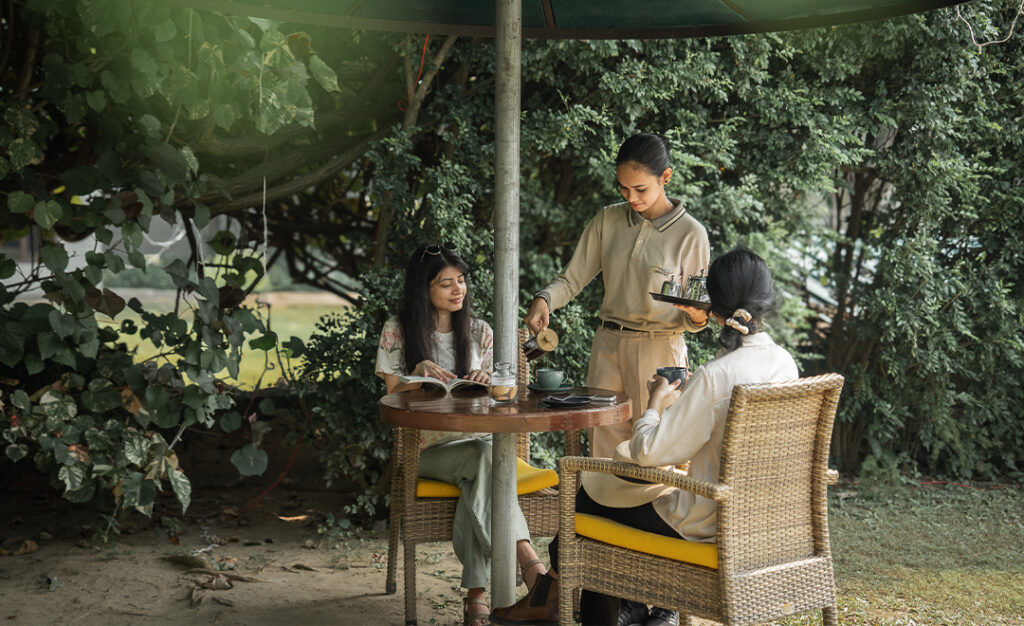
At Aahana, the setting matters as much as the meal itself. Alongside different dining menus, the experience changes with where and how they are served. The team arranges picnics with special menus across the estate, lunches on your balcony or private gazebos if you prefer to order in-room dining.
Dinner

Dhikala’s evening spread is an elaborate buffet, or for something more personal, a four-course menu crafted from seasonal produce. If you would rather start outdoors, the Poolside Barbecue does appetizers well, and you can move to an à la carte dinner from there. Most evenings find a pace of their own.
Experiences Worth Your Time

The Spa L’Occitane en Provence at Aahana is the only Spa L’Occitane within India’s National Parks, bringing the brand’s Provençal wellness philosophy to the edge of Jim Corbett’s forests. Skylit treatment rooms overlook the national park boundary, while outdoor jacuzzis sit beneath the forest canopy itself. Weekend appointments, particularly post-safari slots, are worth booking in advance.
Or, for something quieter, a naturalist-led birding walk along the estate trail offers a different kind of reset entirely.
One Safari Done Right Beats Two Done Badly
This is the most important planning decision of any Corbett trip, and the most consistently mismanaged.
The instinct is to maximise: morning safari, evening safari, a local excursion in between. In practice, a safari is four hours in an open jeep on forest roads. Add preparation time, the forty-minute buffer before departure, the dust, the early hour, and you have consumed the better part of a day. Stack another activity on top and you return to the resort exhausted, having not absorbed any of it.
Corbett is a nature-forward destination. People genuinely come here to slow down. One safari, done with full attention, is the right pace for most guests. Two safaris are for serious wildlife watchers for whom the forest is the primary reason for making the trip.
The right zones:
For guests staying at Aahana, Dhela and Jhirna are usually the most practical choice. Both are fifteen minutes away, and very popular zones. The alternative is a long drive through Ramnagar’s main stretch before you even reach the forest, which adds unnecessary time to an already early morning or a late evening return.
Safari timings:
Winter: Morning, 6am to 10am | Evening, 1pm to 5pm.
Summer and Monsoon: Morning, 5:30am to 9:30am | Evening, 3pm to 7pm.
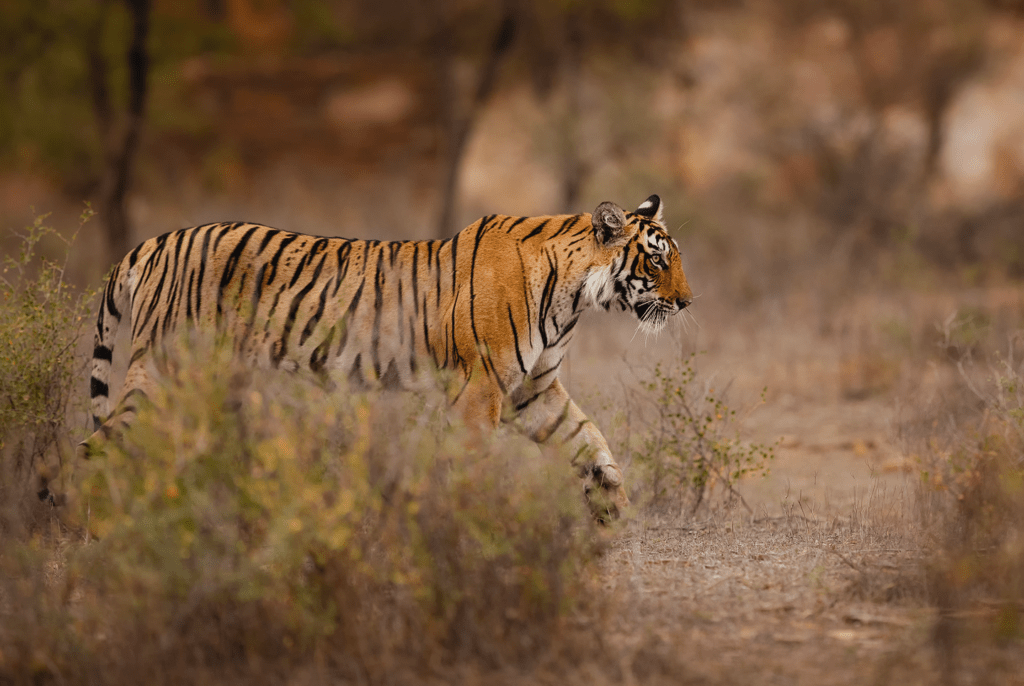
The four hours inside the forest are the point. Stay for all of them. Tigers are most active in the earliest hours of the morning and the final hours of the evening. Wildlife movement is unpredictable: the forest does not perform on a schedule. But staying present and alert for the full duration is what gives you a genuine chance.
On permits:
Safari permits are issued by the government and are non-transferable. They are assigned to the names of the individuals entering the park: no one can book on your behalf and hand them over. Dhela and Jhirna are among the region’s most popular safari zones. Peak season weekend slots fill two or more weeks in advance. Long weekend permits sometimes sell out within days of becoming available.
The practical point: check the official Corbett Tiger Reserve website, decide your dates, and book early. If you are booking your safari through Aahana, do so at least three days before arrival. This allows the team to assign a preferred jeep vendor and ensure the quality of both vehicle and driver. Book later and the rotation system allocates automatically: the jeep will still be coordinated, but advance booking gives the team room to do it properly. If part of the luxury of the weekend is having things handled before you arrive, this is worth sorting in advance.
For photographers:
If you are travelling solo or as a pair and shooting seriously, inform Aahana in advance. The middle seat of the jeep can be removed, giving you unrestricted access to your gear and the physical space to work throughout all four hours.
On jeep capacity:
A standard safari jeep seats six: three in the middle row, three in the back. For a family of four adults and two children, the jeep is full. It is manageable; it is not comfortable. Especially with younger children, two jeeps is a meaningful upgrade to the experience.
If You Have More Time
Three nights is when Jim Corbett stops feeling like a schedule. Four is when it begins to feel like a place.
With more time, the region opens up. Aahana arranges picnics by the Ramganga river, at spots away from any tourist circuit. Mountain drives on clear days to viewing points where the Himalayan peaks sit on the horizon, though the micro-climate around the peaks makes exact visibility unpredictable. A private visit to a local family for a taste of village life that no organised tour replicates.
And Baraati Rao waterfall: a 45-minute drive and a 30-minute walk. Not the waterfall that appears in every list of Corbett attractions. It is quieter, less visited, and worth the effort. Go early on weekends.
For guests with an interest in the region’s spiritual life, Garjia Devi Temple sits on the banks of the Kosi and is meaningful without being crowded if you time it right.
Many guests prefer relaxing at the resort and occasionally stepping out for simple experiences such as a horse-driven heritage buggy ride through the local village.
None of these experiences comfortably fit into a two-night weekend, which is worth keeping in mind when deciding how long to stay.


What to Book in Advance
Safari permits: Two weeks minimum for peak season weekends. Long weekends and school holidays sell out faster. Book with Aahana at least three days before arrival for quality control on the vehicle and driver.
Spa appointments: 24 hours minimum. Saturday afternoon slots go first.
Private pool villas: Five on the property. If you are travelling as two families or a multi-generational group, this is the correct choice: four bedrooms, private temperature-controlled pool, butler service, and attached nanny rooms. They book early on long weekends and school holiday dates.
Frequently Asked Questions
How far is Jim Corbett from Delhi?
Approximately 260 kilometres by road. The drive takes between four and a half and five hours on a clear day.
How much time is enough for Jim Corbett?
Two nights is the minimum for a meaningful Jim Corbett weekend. Three nights is when the experience becomes what it should be: one safari, real rest, and time to absorb the place rather than move through it.
Is Jim Corbett open during monsoon?
Jhirna and Dhela zones are open year-round. The monsoon forest is dense, green, and actively interesting. It is one of the most underrated seasons in the region.
How far in advance do I need to book safari permits?
Two weeks minimum for peak season weekends. Long weekends and school holidays can sell out within days of permits becoming available. Permits are government-issued and non-transferable.
Is Jim Corbett safari suitable for children?
Yes, from around four to five years old. Preparation matters more than age: brief them before the morning, dress them correctly for the season, and keep the day simple. One safari is enough.
Is there an evening safari at Jim Corbett?
Yes. Winter: 1pm to 5pm. Summer and Monsoon: 3pm to 7pm. Evening safaris are worth their timing: wildlife activity increases in the later hours and the light in the forest is different.
What should I wear on a Jim Corbett safari?
Forest colours: greens, browns, neutrals. No perfume. A dust cover for the face. Warm layers in winter. Light and breathable in summer, with sun protection and water.